 Account
EAW Adaptive Line Array System: The Future of Live Sound Deployment
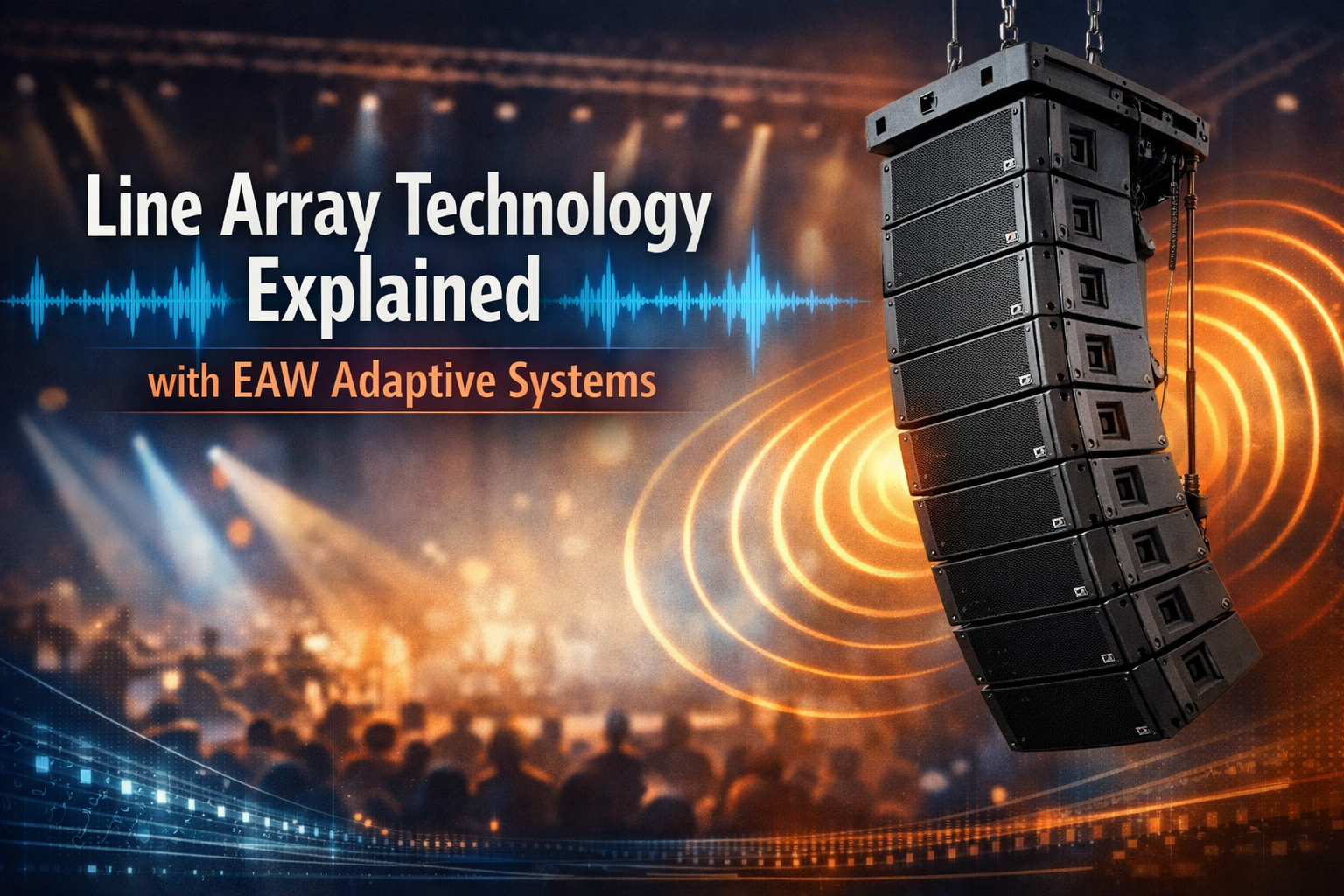
When we attend a concert or a large live event, sound quality plays a major role in the overall experience. Clear vocals, balanced music, and even coverage across the audience are expected as a standard today. The EAW Adaptive Line Array System has been developed to meet these expectations by changing how professional sound systems are designed and deployed. It offers a smarter and more efficient alternative to traditional line array setups, especially for modern live sound applications.
What Is the EAW Adaptive Line Array System?
The EAW Adaptive Line Array System is an advanced loudspeaker solution from EAW that uses digital processing to control sound coverage. Unlike conventional line arrays that depend on physical cabinet angles, this system manages dispersion electronically. As a result, the entire speaker array can be hung straight while still delivering accurate and consistent coverage across the venue. This approach reduces complexity and improves reliability during live events.
Traditional J-Curve vs Adaptive Straight Hang
For many years, J-curve line arrays have been the standard in concerts and large venues. They work well but often require precise angle calculations and experienced technicians on site. The adaptive straight-hang approach simplifies this process by moving most of the planning into the design stage.
Key differences include:
-
J-curve systems rely on physical angles for coverage
-
Adaptive systems use digital control for dispersion
-
Straight hang deployment reduces setup time
-
Results are more predictable from venue to venue
By removing the need for mechanical adjustments, adaptive systems make live sound deployment faster and more efficient.
How EAW Adaptive Line Array System Technology Manages Sound Coverage
One common question is how sound coverage remains even without a curved array. In the EAW Adaptive Line Array System, coverage is controlled through intelligent processing rather than physical alignment. Each speaker cabinet is programmed to cover a specific area of the audience, ensuring uniform sound from the front rows to the back.
This process includes:
-
Designing the venue digitally before the event
-
Assigning coverage zones to each cabinet
-
Controlling output and frequency response electronically
The result is consistent sound quality, improved speech clarity, and balanced audio across the entire listening area.
Software-Based Design for Real Venues
Before the system is installed on site, sound engineers design the entire setup using dedicated software. This step allows them to visualize the venue, place the speaker arrays accurately, and calculate performance in advance. Once the design is complete, presets are created and uploaded to the speakers.
This workflow offers several advantages:
-
Less time spent on physical setup
-
Minimal on-site adjustments
-
Greater confidence in system performance
For touring engineers and event professionals, this software-driven approach saves time and reduces stress during live productions.
Benefits for Sound Engineers and Event Professionals
The EAW Adaptive Line Array System is especially valuable for professionals who work across different venues and tight schedules. Its design supports fast deployment and consistent results, making it suitable for both touring and fixed installations.
Key benefits include:
-
Faster setup and teardown
-
Reliable and repeatable performance
-
Reduced dependence on complex rigging adjustments
-
More focus on mixing and show quality
Rental companies and event production teams also benefit from improved efficiency and smoother operations across multiple events.
Final Thoughts
The EAW Adaptive Line Array System represents a significant evolution in live sound technology. While traditional J-curve line arrays are still widely used, adaptive straight-hang systems offer clear advantages in terms of speed, accuracy, and consistency. By combining intelligent software design with digital control, this system delivers high-quality sound while simplifying the entire deployment process.
As live events continue to grow in scale and complexity, adaptive line array systems are becoming an important part of the future of professional audio. For anyone looking to deliver reliable sound with greater efficiency, the EAW Adaptive Line Array System stands out as a forward-thinking solution.
We are also launching a Tech Charcha series where we will talk in detail about EAW and its Adaptive Series, covering real setups, practical use cases, and on-ground experiences from live events. If you want to understand how adaptive line array systems work in real-world situations, stay tuned and follow us on our Instagram and YouTube channels for upcoming episodes and insights, or contact us for more information.