 January 21, 2026
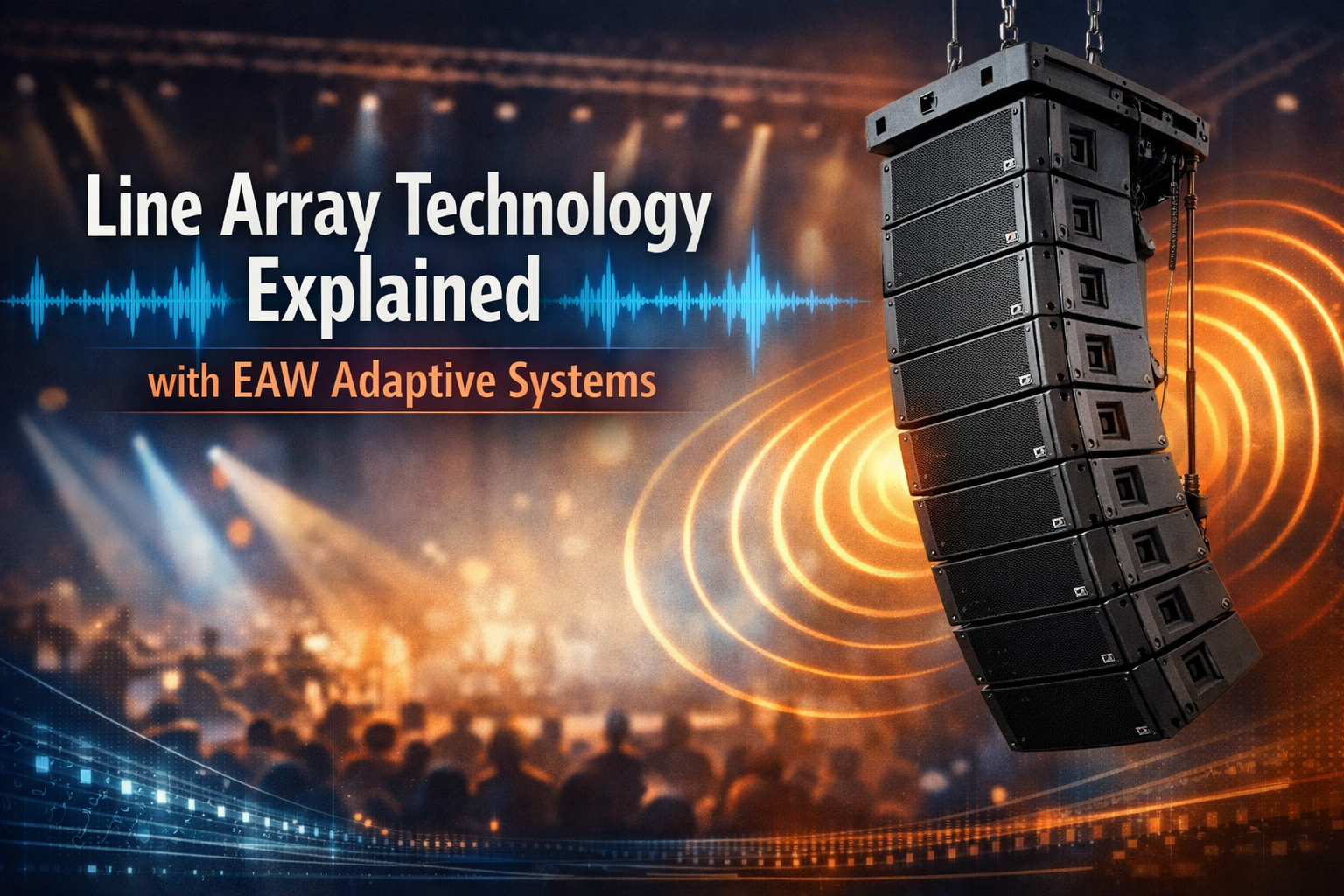
For years, the line array has been the backbone of professional sound reinforcement. You’ll find it everywhere—concerts, festivals, auditoriums, big venues—because it can throw sound evenly across long distances. But here’s the thing. Traditional line array systems rely a lot on mechanical design, and once they’re installed, flexibility drops fast. The EAW Adaptive System steps in with a smarter approach, changing how a modern line array actually behaves.
This blog breaks down how the EAW Adaptive line array differs from conventional systems and explains how coverage can be adjusted during a live show, without touching the rigging. No drama.
In a conventional line array, coverage is shaped by physically curving the array and locking in fixed angles between cabinets. Those angles decide how sound spreads across the audience. Once the system is flown and aligned, that coverage stays the same for the entire event. Period.
If the audience layout changes or the venue demands something different, adjusting coverage mid-show is extremely hard. Sometimes impossible. That lack of flexibility is one of the biggest pain points with traditional line array systems. A real limitation.
The EAW Adaptive line array takes a different route by using a straight hang design instead of a curved array. All cabinets are flown in a straight vertical line, which makes rigging simpler and setup quicker. It may look unusual at first glance, but the real innovation is hidden inside the enclosure.
Unlike conventional systems, the EAW Adaptive line array lets engineers modify sound coverage during the show without physically moving the speakers. This works through advanced digital signal processing and intelligent control of the drivers in each cabinet. Smart, not mechanical.
One of the biggest advantages of the EAW Adaptive system is its ability to change coverage without mechanical movement. Instead of relying on physical angles, the system uses driver density and enclosure design to steer sound electronically. Clean and efficient.
Key advantages of this adaptive approach include:
• Real-time control of sound coverage
• No need for mechanical or rigging changes
• Faster setup and improved safety
• Better flexibility for changing venue layouts
Because of this technology, it can behave like a curved system while staying in a straight hang configuration. Kind of clever.
Driver density is central to how the EAW Adaptive performs. The enclosure houses multiple high-frequency, mid-frequency, and low-frequency drivers, all controlled digitally for precise results.
In the top-tier adaptive system, ANYA, the enclosure includes fourteen high-frequency drivers, six mid-frequency drivers, and two powerful, fifteen-inch low-frequency drivers. This high driver count gives engineers detailed control over sound direction, throw distance, and vertical coverage, making it ideal for large and complex venues.
Anna, the more compact adaptive system, follows the same design philosophy. It features eight high-frequency drivers, four mid-frequency drivers, and two ten-inch low-frequency drivers. Smaller footprint, strong performance. Despite its size, Anna offers impressive control and flexibility for medium-sized venues.
Because each driver group in the adaptive can be controlled independently, the system doesn’t depend on mechanical curvature to shape coverage. This allows the array to remain in a straight hang while still delivering accurate, adjustable sound.
This approach cuts setup time, removes the need for physical changes during a live show, and lets engineers react instantly to venue demands. No interruptions. Just control.
• A traditional system depends on fixed mechanical angles and offers limited flexibility once installed.
• An EAW Adaptive uses digital control to adjust coverage in real time, without any physical movement.
The EAW Adaptive system marks a major step forward in its design. By moving control from mechanical adjustments to intelligent digital processing, it delivers higher flexibility, better precision, and consistent performance.
As live events continue to grow larger and more complex, adaptive systems like EAW’s are setting a new standard for the future of professional audio. And honestly. It feels overdue.
We are also launching a Tech Charcha series, where we will discuss EAW and its Adaptive Series in detail, covering real setups, practical use cases, and on-the-ground experiences from live events. To gain a deeper understanding of how adaptive line array systems function in real-world scenarios, follow us on our Instagram and YouTube channels for upcoming episodes and valuable insights, or contact us for more information.
Share this Blog January 14, 2026
Why Adaptive Line Array Systems Are Essential for Live Sound Engineers Live sound engineering has changed a lot in recent years. Venues keep getting bigger, audiences expect more, and setup time feels shorter every season. In this fast-moving space, Adaptive...
Read More January 13, 2026
EAW Adaptive Line Array System: The Future of Live Sound Deployment When we attend a concert or a large live event, sound quality plays a major role in the overall experience. Clear vocals, balanced music, and even coverage across the...
Read More May 22, 2025
We are proud to share that Pink Noise Professionals has been featured on the official EAW website for facilitating the first-ever deployment of the EAW Anya Adaptive Sound System in India. This recognition marks a significant milestone for us, as...
Read More
 Account