
Line Array Technology Explained with EAW Adaptive Systems

How the EAW Adaptive System Redefines Line Array Technology

For years, the line array has been the backbone of professional sound reinforcement. You’ll find it everywhere—concerts, festivals, auditoriums, big venues—because it can throw sound evenly across long distances. But here’s the thing. Traditional line array systems rely a lot on mechanical design, and once they’re installed, flexibility drops fast. The EAW Adaptive System steps in with a smarter approach, changing how a modern line array actually behaves.

This blog breaks down how the EAW Adaptive line array differs from conventional systems and explains how coverage can be adjusted during a live show, without touching the rigging. No drama.

How Conventional Line Array Systems Work

In a conventional line array, coverage is shaped by physically curving the array and locking in fixed angles between cabinets. Those angles decide how sound spreads across the audience. Once the system is flown and aligned, that coverage stays the same for the entire event. Period.

If the audience layout changes or the venue demands something different, adjusting coverage mid-show is extremely hard. Sometimes impossible. That lack of flexibility is one of the biggest pain points with traditional line array systems. A real limitation.

The EAW Adaptive Line Array Approach

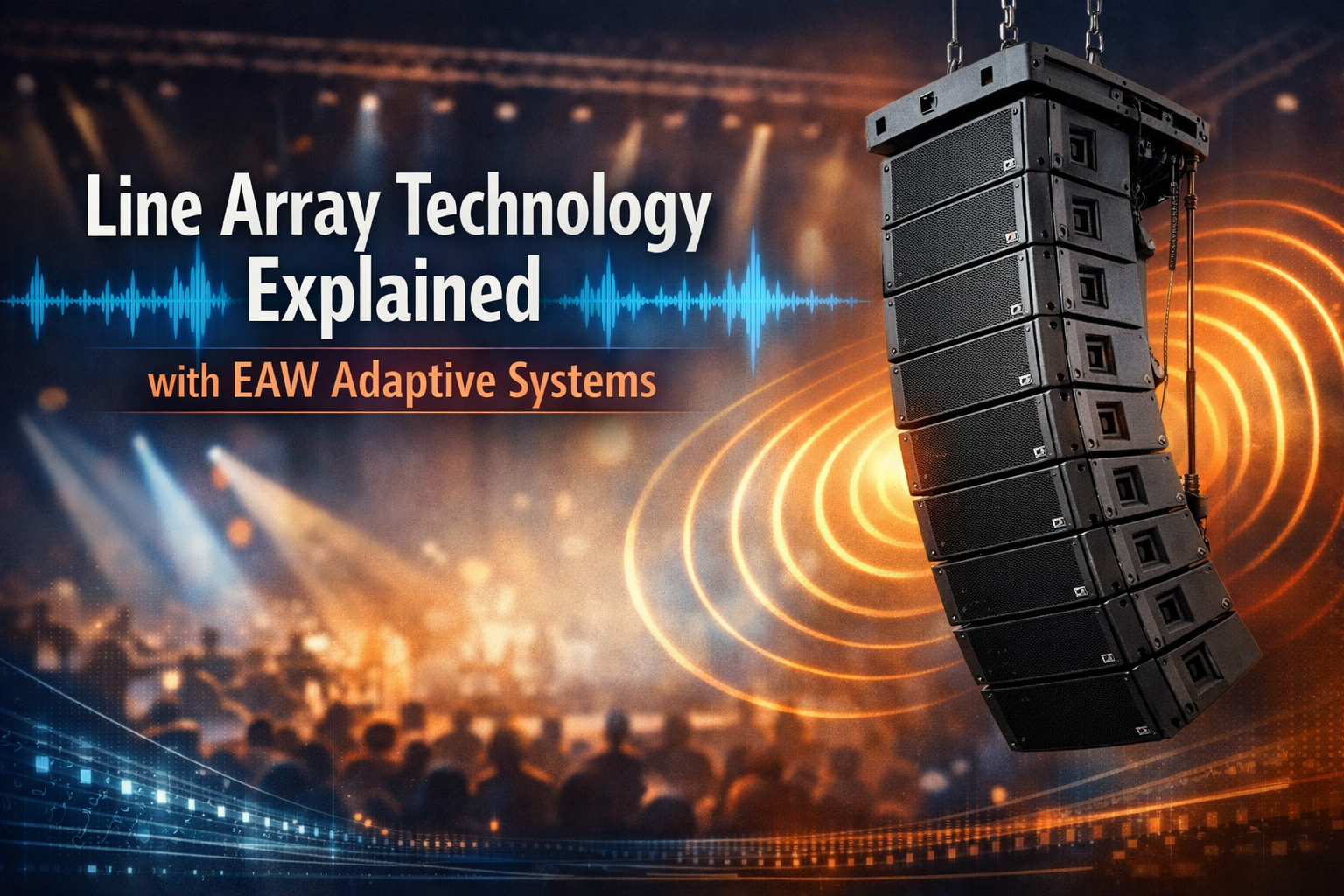
The EAW Adaptive line array takes a different route by using a straight hang design instead of a curved array. All cabinets are flown in a straight vertical line, which makes rigging simpler and setup quicker. It may look unusual at first glance, but the real innovation is hidden inside the enclosure.

Unlike conventional systems, the EAW Adaptive line array lets engineers modify sound coverage during the show without physically moving the speakers. This works through advanced digital signal processing and intelligent control of the drivers in each cabinet. Smart, not mechanical.

How Coverage Can Change During the Show

One of the biggest advantages of the EAW Adaptive system is its ability to change coverage without mechanical movement. Instead of relying on physical angles, the system uses driver density and enclosure design to steer sound electronically. Clean and efficient.

Key advantages of this adaptive approach include:
• Real-time control of sound coverage
• No need for mechanical or rigging changes
• Faster setup and improved safety
• Better flexibility for changing venue layouts

Because of this technology, it can behave like a curved system while staying in a straight hang configuration. Kind of clever.

Driver Density and Enclosure Design

Driver density is central to how the EAW Adaptive performs. The enclosure houses multiple high-frequency, mid-frequency, and low-frequency drivers, all controlled digitally for precise results.

In the top-tier adaptive system, ANYA, the enclosure includes fourteen high-frequency drivers, six mid-frequency drivers, and two powerful, fifteen-inch low-frequency drivers. This high driver count gives engineers detailed control over sound direction, throw distance, and vertical coverage, making it ideal for large and complex venues.

Anna, the more compact adaptive system, follows the same design philosophy. It features eight high-frequency drivers, four mid-frequency drivers, and two ten-inch low-frequency drivers. Smaller footprint, strong performance. Despite its size, Anna offers impressive control and flexibility for medium-sized venues.

Why a Straight Hang Line Array Works Better

Because each driver group in the adaptive can be controlled independently, the system doesn’t depend on mechanical curvature to shape coverage. This allows the array to remain in a straight hang while still delivering accurate, adjustable sound.

This approach cuts setup time, removes the need for physical changes during a live show, and lets engineers react instantly to venue demands. No interruptions. Just control.

Traditional Line Array vs EAW Adaptive Line Array

• A traditional system depends on fixed mechanical angles and offers limited flexibility once installed.
• An EAW Adaptive uses digital control to adjust coverage in real time, without any physical movement.

The Future of Line Array Technology

The EAW Adaptive system marks a major step forward in its design. By moving control from mechanical adjustments to intelligent digital processing, it delivers higher flexibility, better precision, and consistent performance.

As live events continue to grow larger and more complex, adaptive systems like EAW’s are setting a new standard for the future of professional audio. And honestly. It feels overdue.

We are also launching a Tech Charcha series, where we will discuss EAW and its Adaptive Series in detail, covering real setups, practical use cases, and on-the-ground experiences from live events. To gain a deeper understanding of how adaptive line array systems function in real-world scenarios, follow us on our Instagram and YouTube channels for upcoming episodes and valuable insights, or contact us for more information.

Why Adaptive Line Array Systems Matter for Sound Engineers

Why Adaptive Line Array Systems Are Essential for Live Sound Engineers

Live sound engineering has changed a lot in recent years. Venues keep getting bigger, audiences expect more, and setup time feels shorter every season. In this fast-moving space, Adaptive Line Array Systems have become a practical answer for engineers and audio professionals handling live events. They bring more control, better consistency, and higher efficiency than traditional line arrays, which makes them a strong fit for today’s demanding workflows.

The speaker technology matters, of course. But the real edge appears when Adaptive Line Array Systems are paired with smart prediction tools like Resolution software. That combination helps engineers plan clearly and execute with confidence. Less guesswork. More certainty.

Understanding Adaptive Line Array Systems

Adaptive Line Array Systems are built to manage sound coverage electronically instead of depending only on physical angles and mechanical changes. This lets engineers shape sound accurately across the audience area, keeping clarity steady from the front row to the last seat.

For live events, that’s a big deal. Engineers can maintain controlled coverage even in tricky venues, outdoor shows, or temporary setups where acoustics can shift without warning. Sometimes wildly.

Why Live Sound Engineers Prefer Adaptive Line Array Systems

Live events come with their own set of pressures, and solutions need to be fast and reliable. Adaptive Line Array Systems answer that need with a smarter and more predictable workflow.

Key benefits for engineers include:

• More even sound coverage across large audience areas
• Less need for physical changes during setup
• Greater control over system behavior as conditions change

All of this frees audio professionals to focus on sound quality instead of fighting system limits. Which matters.

Predictable Performance in High-Pressure Environments

One major reason engineers trust Adaptive Line Array Systems is predictability. When schedules are tight and expectations are high, knowing what the system will do ahead of time is incredibly valuable.

This is where Resolution software becomes important. Built for EAW systems, Resolution lets engineers simulate the venue and audience layout before anything is installed. By defining audience zones and placing the system digitally, coverage and performance can be reviewed well before show day. A relief.

How Resolution Software Enhances Adaptive Line Array Systems

Resolution software works as a planning and verification tool that strengthens Adaptive Line Array Systems. Engineers can check whether their design choices will hold up in real conditions, reducing uncertainty during installation.

With predictive modeling, Resolution helps engineers:

• Visualize audience coverage
• Evaluate system interaction and balance
• Spot potential issues early in the design phase

This kind of preparation speeds things up once on site.

Faster Setup and Smarter Deployment

In live production, time is everything. Adaptive Line Array Systems, when designed using Resolution software, can dramatically cut setup and tuning time. After the system is installed, engineers connect to the network and load the pre-designed configuration.

Because the system was already tested digitally, only minimal changes are needed on-site. This streamlined approach is especially helpful for touring shows and large events. No rushing. Fewer surprises.

Consistency Across Different Venues

Keeping sound consistent from venue to venue is a constant challenge. It helps solve this by allowing engineers to reuse proven designs while adjusting for different audience layouts.

With Resolution software, audience size and system placement can be updated while keeping the same performance targets. This leads to reliable results in indoor halls, outdoor stages, and temporary event spaces. Again and again.

Reduced Physical Complexity for Audio Teams

Traditional line arrays often require exact mechanical angles and repeated adjustments. Reduce that burden by shifting much of the optimization into electronic control.

Resolution software supports this by making sure the system is planned correctly from the start. The result is less re-rigging, improved safety, and saved time for system technicians. Simple wins.

Building Confidence Through Data and Prediction

Today’s audio professionals depend on data to make confident decisions. It is backed by Resolution software give clear insight into how the system will behave, even before the event begins.

This predictive approach builds trust and lets engineers approach live shows with more control and less stress. Calm matters.

Conclusion

Adaptive Technoogy are now a core part of modern live sound production, offering flexibility, control, and consistent performance. When paired with Resolution software, they allow engineers to predict results, simplify deployment, and deliver reliable sound under pressure.

For live sound engineers and audio technicians, combining it with smart planning tools like Resolution creates a more efficient workflow—one that meets today’s live event demands with confidence and precision.

We are also launching a Tech Charcha series, where we will discuss EAW and its Adaptive Series in detail, covering real setups, practical use cases, and on-the-ground experiences from live events. To gain a deeper understanding of how adaptive line array systems function in real-world scenarios, follow us on our Instagram and YouTube channels for upcoming episodes and valuable insights, or contact us for more information.

GET SOCIAL WITH US & STAY UP TO DATE!